Gasoline Prices and the Public Interest
The Consumer Advocate's Report on Gasoline Prices
in the Province of Newfoundland and Labrador
CHAPTER THREE
Trend - Rationalization
According to Ervin, the number of gasoline retail stations in Canada has declined from 22,000 outlets in 1989 to approximately 16,500 in 1995.(29) Octane Magazine estimates that there were 14,513 stations operating in 1995.(30)
The reason for the fairly significant divergence in the number of outlets operating in Canada was never fully explained. As surprising as it may seem, this basic piece of information concerning the industry is one of the most elusive to obtain. The difficulty encountered in obtaining this data is experienced by all monitoring agencies, including Natural Resources Canada and the Province's Department of Mines and Energy.
While the market participants provided detailed information concerning their retail operations in the province, collectively, their replies did not provide a complete picture of this aspect of the industry.
It was determined however, that the number of retail stations operating in the province could be approximated from an independent source of information.(31)The information received through this source confirms that the rationalization taking place in Canada is also being experienced in Newfoundland and Labrador. In 1992, there were approximately 708 stations operating in Newfoundland and Labrador. By 1995 this number had declined to 643 operating stations, a drop of 9.2%. The number of stations which actually closed during this period would have been greater than this net decline of 65 outlets, if new stations had not opened at selected sites in the same time frame.(32) The number of operating stations shrunk to 545 by September of 1997, a full 23% decline from 1992.
The retail gasoline trade is considered to be a mature industry. In the rare instance that a market in Newfoundland and Labrador is being under-serviced, it is usually attributable to a geographic shift in the population base, such as when a new subdivision is built in an urban area, and not as a result of a growth in total sales.
There has been little growth in the retail market for gasoline.(33) The average consumption of gasoline in Canada declined 28% from 1980 to 1990. Nationally, total volumes have remained virtually unchanged from five years ago.(34) This is predictable given the introduction of more fuel efficient vehicles into the population, together with the retirement of older vehicles. The national forecast is for an anemic 0.6% annual growth rate to 2005.(35)
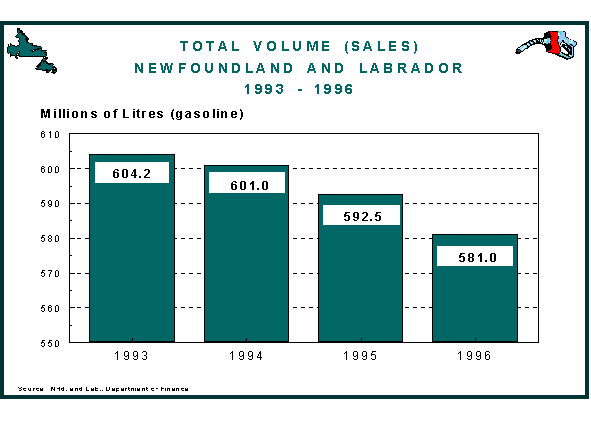
In Newfoundland and Labrador, the decline in the 1980s has continued into the 1990s. The total volume of gasoline sold in the Province has dropped from 604 million litres in 1993 to 581 million litres in 1996(36), a decrease of 3.8%.
This decline in total sales is predictable given that the Province's population base has remained stagnant and the fact that people consume, on average, less gasoline than in the past. Generally, the gasoline retail industry in Canada is over-supplied.(37) As retail margins shrink(38) and the total market volume decreases, operators are driven to increase efficiencies.
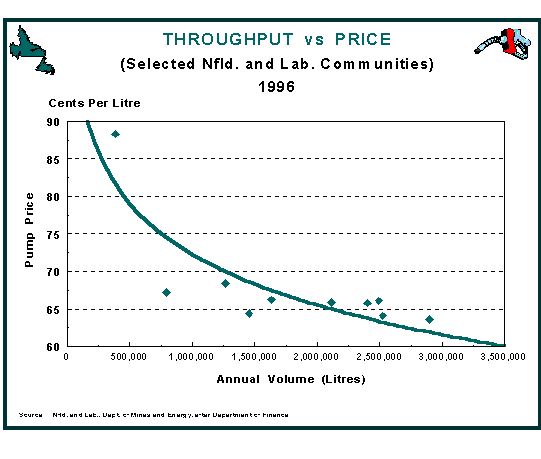
It has been suggested that at the present levels of obtainable retail margins, a station operator must sell a minimum of 1.5 million litres of gasoline yearly.(39)An Independent interviewed during the study indicated that the minimum throughput required to warrant construction of a new outlet was in the order of 3.5 million litres. Given that a number of stations in the Province sell significantly higher volumes than the average throughput of 1 million litres (some in excess of three million litres of gasoline yearly(40)) , it necessarily follows that there are a number of stations in operation whose total volume of sales may not exceed any more than 200,000 litres annually.
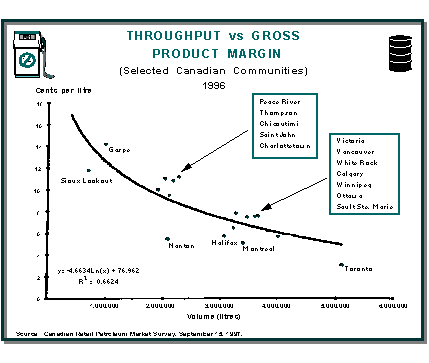
At a gross retail margin of five cents per litre, a 500,000 litre per year outlet would gross $25,000 annually. In order to survive, this station must either realize a greater retail margin than the industry norm of five or six cents a litre, significantly increase the station's throughput or raise additional revenue through ancillary services. In areas where a significant increase in throughput is unattainable, the response has been to raise the price in order to increase the retail margin. This explains in part why the price of gasoline is higher in some markets than in others. This inverse relationship between the volume of gasoline sold and the price charged for gasoline in a given centre has been well documented in the Ervin Report.
This trend is also evident in the Newfoundland and Labrador market.
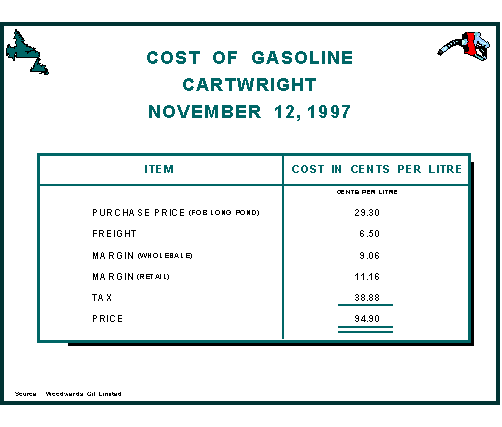
In Cartwright, Labrador the price of gasoline, at the commencement of this Study, was 94.9 cents a litre.(41) With a total population of 660, the expected total volume of gasoline sold in the community would not exceed 700,000 litres yearly.(42) The actual total usage is approximately 480,000 litres.(43)If each of the two stations operating in Cartwright shared equally between them the total volume, each would have a throughput of no more than 240,000 litres yearly.
Given that the gasoline sold in Cartwright must be shipped to the Town and stockpiled for the winter, the operator would need to recover a gross retail margin higher than in St. John's.
In other regions of the Province, station owners have increased efficiencies both by increasing volumes and finding alternative sources of revenue. An increase in volume can be achieved in two ways, by decreasing the number of stations operating and by attracting more customers to the station. The latter approach, that of increasing station visits, has been achieved by evolving from the traditional gasoline outlet to a modern multi-service, multi-pump retail convenience centre.
In the past, market participants owned and operated stations with one or two pumps, a service bay and in some cases a small retail store focused on automobile related goods, such as tires, batteries and wiper blades. In more recent times, market participants have embarked on an aggressive marketing program borne from a change in philosophy from seeing themselves as operators of gasoline stations to owners of "retail convenience real estate"(44). In effect, the market participants, wherever possible, have upgraded existing stations to multi-island gasoline outlets which contain convenience stores, fast food kiosks, coffee corners, and car washes.
At a cost to build of in excess of $2,000,000,(45)a new or refurbished retail outlet must derive a significant portion of its income from the sale of non-gasoline related products in order to survive. In effect, the operator of the outlet banks on a customer spending $20.00 for gas, from which the outlet may realize a gross retail margin of $1.80,(46) and this same customer spending a further $20.00 on juice, bananas, coffee, or fast food from which the outlet may obtain a gross retail margin in the vicinity of $5.00.(47) Referred to as ancillary revenues, these additional sources of income have become crucial to the individual outlet operator remaining viable, as it is otherwise very difficult for the operator of a new station to recover its operating costs, let alone make a profit.
In a recent decision of the Public Utilities Board, Newfoundland Light and Power was awarded a 10.5% rate of return on its total investment, the Commissioners having determined that this was a fair and reasonable rate of return for the power company, recognizing the level of risk to which an investor would be exposed(48).
Arguably, the retail of gasoline presents a significantly greater risk to the investor than would Newfoundland Power. However, a review of the 1995 and 1996 annual reports of the publicly traded integrated oil companies reveal that the refining and marketing operations had returns on capital employed in the range of 6.0% to 8.0%.
In order to earn a rate of return equal to Newfoundland Power, a modern multi-service, multi-pump gasoline outlet may need to sell in excess of 3.75 million litres of gasoline annually.(49) While achievable for some locations, it is reasonable to conclude that not every site warrants a $2,000,000 investment. Accordingly, some isolated micro-markets in the province will not benefit from the efficiencies achieved through this process . One result will be a perpetuation of the variation in price between urban and rural areas of the Province.
Based upon discussions with market participants, and the experience gained in other jurisdictions, it is expected that the rationalization process will continue into the immediate future. A further decline of 10-15% in the number of outlets operating in the Province would not be unexpected.(50)
Effect of Rationalization on Level of Competition
The process of rationalization in the retail gasoline industry raises concern with the level of competition in the remaining market. Fewer stations generally means less competition.
The expressed objective of the rationalization is to improve the throughputs of the remaining stations. In theory, these remaining stations will be able to survive on a smaller gross retail margin and will pass these increased efficiencies on to customers.
If a station selling regular unleaded gasoline at the current price of 67.9¢ per litre(51) is minimally viable at a throughput of 1.5 million litres yearly, a low volume station (500,000 litres annually), with an equal amount of capital employed in the outlet and generally the same operating costs, would need to sell that same litre of regular unleaded gasoline at approximately 82¢ a litre(52)in order to earn the same return.
While the objective of rationalization, to improve efficiencies and therefore provide lower prices, is commendable, the continued trend towards fewer stations can have the opposite effect to what is intended. Ervin writes:
In very small markets, reducing the number of outlets may also reduce the number of competitors to a small handful. Any fewer than 3-5 competitors in an isolated market could actually inhibit competition.(53)
The province is not without its share of isolated markets. As a legacy to its predominantly rural structure, Newfoundland and Labrador is dotted with what can be considered isolated micro markets. Places such as St. Brendan's, Cartwright, Burgeo, and St. Anthony are self-contained, geographically defined micro markets. Places such as Grand Falls-Windsor, while not "isolated" in the same sense as Cartwright, are, nonetheless, isolated for the purposes of the retail gasoline business. It is obvious that a consumer living in Grand Falls cannot drive to Gander to take advantage of a lower price at the pump. In many of these isolated micro markets, there are fewer than the "3-5 competitors" below which competition may actually be inhibited. As such, the market may display oligopolistic behaviour.
By example, in the Town of Grand Falls-Windsor, there are only two competitors left to service the market, Irving Oil and Ultramar, Imperial Oil having vacated the market in 1996. The Town has approximately 16,000 residents and seven outlets currently in operation, down from 13 outlets five years ago. Irving operates a convenience store in three of its four outlets. One of the three Ultramar stations is a Pipeline, offering a multi-service operation to the customer. Assuming that the residents of Grand Falls-Windsor consume, on average, a similar amount of gasoline to that of other residents in the Province, each station should have an average throughput of approximately 2.5 million litres, double what the throughput would have been five years ago. However, industry supplied figures would not seem to support these totals.(54) In any event, with half as many stations as five years ago, the remaining stations' volumes should be, on average, twice as high as their 1992 totals. At issue is whether the gross margins earned by outlets located in Grand Falls are comparable to other markets in the Province with similar throughputs or whether the shortage of competitors in Grand Falls-Windsor has inhibited competition.
A similar concern was addressed in the New Brunswick inquiry, which, after detailing the variation in prices within the province, concluded(55):
"... a substantial portion of the 4 cent per litre differential is not explainable by the cost factors. Market factors, specifically a lack of competition in the market from 1991 to 1995 are believed to account for the difference...."
An often heard complaint made by consumers is of finding the "same price everywhere". To many consumers, this "same price everywhere" phenomena only serves to confirm their suspicions that the major oil companies are cooperating with each other. Whether considered demonstrative of implicitly agreed upon fence sitting or outright collusion, the "same price everywhere" phenomena is a constant source of consumer suspicion and frustration. However, the "same price everywhere" phenomena is a product of consumer behaviour, and, in many instances, should be viewed as a sign that competitive forces are at play in the marketplace.(56)
In 1993, the Government of Newfoundland and Labrador introduced price posting regulations for the retail gasoline industry. These regulations required station owners to post prices in plain view, so that a passing motorist could instantly see what the station was charging for their product. This is known as curb-side pricing.
It was suggested that the average consumer will drive across the street if another dealer is selling gasoline 0.2¢ per litre cheaper.(57) It should be noted that this would represent savings of less than ten cents on a fifty litre fill up. While there was no empirical evidence to support this specific assertion, it is clear from anecdotal evidence that consumers generally display a high degree of sensitivity towards the price of gasoline.
During 1997, certain areas of the province experienced price wars. The modelling of the dynamics or game theory in price wars is in its infancy and remains speculative(58). As discussed earlier in this report, price wars commence as a result of one station owner dropping the price. Usually the station owner enjoys, albeit temporarily, a marked increase in market share. The competition must respond to maintain their market share. Eventually, the price drops to a floor at which neither operator is making money.(59)In the end, both station owners are forced to restore their price to a viable level.
Station owners, understandably, are reluctant to start a price war. Price wars rarely create long term shifts in market share. Lerner writes(60), "Price wars break out frequently in gasoline markets even though the conditions necessary for profiting from reducing a posted price are not satisfied." Only in instances where an operator has been forced from the market as a result of a prolonged price war, or a new station owner obtains a foothold in the market place by drawing attention to its presence through cheaper prices, is there any significant long term effect in the market share enjoyed by competitors.
Since price wars rarely have a long term impact on market share, and the price charged for gasoline is often posted for public view, market prices tend to converge. The end result is that the consumer sees the "same price everywhere".
By analogy, in the financial sector, most banks charge identical interest rates on residential mortgages. Whether the mortgage is for a six month open term or for five years the posted interest rate will likely be the same no matter which bank the customer uses. Periodic changes in the mortgage rate charged by an individual bank are quickly followed by the other chartered banks. This herd mentality is borne from the same cause that drives the "same price everywhere" phenomena in the gasoline trade, in that small variations in price between competitors can cause quick shifts in the market share enjoyed by the participants.
Although consumers are generally frustrated with what they perceive to be overly high earnings in the banking industry, there seems to be general acceptance that the convergence of interest rates on mortgages is the result of consumer behaviour and a need by the participants to stay competitive with each other. There was no evidence brought forward which would lead to a different conclusion for the retail gasoline industry.
Another consumer complaint involves the perception that the price of gasoline gyrates and that the major oil companies use changes in the crude oil market to their advantage.(61) The speed at which the price of gasoline responds to increases in the cost of crude oil as compared to decreases, is euphemistically referred to as the "rockets and feathers" approach to pricing. Known in economic parlance as "asymmetric pricing", this issue has been the subject of numerous studies by Industry Canada(62) and most recently by a group of economists, including Assistant Professor Anastasia Lintner of Memorial University's Department of Economics.(63)
The conclusion reached by all who have studied this issue for the Canadian market, is that consumer perception does not reflect the empirical evidence. Hendricks found that the estimated response patterns are consistent with the hypothesis that the pattern is the same for increases in crude oil prices as for decreases in crude oil prices.(64)It would seem that the psychological impact of a price increase, and the ire it raises in the public, taints the consumers' perception of the timeliness of the changes.
Price volatility is, in itself, an indicator of a healthy retail market. When the price of a commodity, such as gasoline, periodically changes in price for reasons other than an increase in the price of crude oil, it can be presumed that the market is behaving as it should in that the market participants are passing through to the consumer any gains in efficiencies experienced by the participant.(65)
Grand Falls-Windsor, Cartwright and St. John's are three distinct isolated markets. Each of these markets display varying degrees of competitiveness.
In each market, the price for gasoline follows the "same price everywhere" trend. This indicates that competitive forces are at play. However, if tested for the second hallmark of competition, price volatility, a different result is achieved.
The St. John's market experiences more price volatility than Grand Falls-Windsor or Cartwright. However, as would be expected, St. John's displays less volatility than other major centres in the Atlantic provinces. In this sense, St. John's, the largest urban centre in the province, can be considered an isolated market. Clearly though, Grand Falls-Windsor and, even more so, Cartwright, are isolated micro markets that suffer from a lower level of competitiveness.
Low price volatility is a direct result of fewer competitors present in the market. With fewer competitors there are fewer participants driven to increase efficiencies and likewise fewer participants to pass along any savings gained as a result of those increased efficiencies. If the trend towards fewer stations in operation continues, the Province will experience an increase in these isolated micro markets being serviced by too few participants.
With fewer than 3 to 5 market participants, it is less likely that the increased efficiencies attributable to higher throughputs will be passed on to the consumer, as would seem to be the case in Grand Falls-Windsor. A micro market may not enjoy the benefits gained through a reduction in outlets. This will manifest itself by a decrease in volatility in the pump price of gasoline, the market rarely moving except when changes in the basic price of crude or the wholesale rack price dictate a change.
Recognizing that there is a legitimate objective driving the rationalization process, a purpose of the Study was to find a mechanism which would strike a balance between the drive towards increased throughputs and maintaining a sufficient level of competitiveness in the resulting marketplace.
30. Infra.
31. Every three years the Government of Newfoundland issues a tender call for the supply of gasoline under a credit card system used in its fleet of vehicles. The individual bids received from each retail operator (Irving, Esso, Ultramar, and Petro Canada) contains a schedule listing of the name and location of all retail stations operated by the individual bidder at the time of submitting the bid.
32. Industry.
33. Ervin Report, Refinery Report.
34. Refinery Report.
35. National Energy Board per Lerner; see also Refinery Report.
36. Government of Newfoundland and Labrador, Department of Finance Data.
37. Ervin Report.
38. Ervin Report, Lerner Economic Report.
39. I.R.G.M.A. Newsletter, July 1997.
40. Industry.
41. After discussion with Industry the price dropped in November, 1997, to 89.9 cents a litre in Cartwright, Black Tickle and Port Hope-Simpson.
42. On average Newfoundlanders use close to the Canadian average of the total volume of gasoline per person of approximately 1,100 litres yearly. Source: Statistics Canada.
43. Industry.
44. Industry.
45. Industry.
46. $20.00 purchase equal to approximately 30 litres - estimated retail margin of six cents per litre.
47. Estimated gross retail margins of general merchandise - 25%.
48. P.U. 7 (1996-97).
49. Based on six cents per litre gross retail margin and $2,000,000 of total investment in capital items. Assuming $50,000 in gross retail margin from ancillary services offsets all operating costs.
50. Industry.
51. Note that during the Study the price of regular unleaded, self-serve gasoline in St. John's declined one cent per litre to its current 67.9¢ a litre.
52. Assuming the gross retail margin gained on the sale of RUL at 67.9¢ is six cents a litre.
53. Ervin Report (draft), p. XIII; NB: This sentence was omitted from the final report.
54. Industry responses imply that the per capita average consumptions in Grand Falls-Windsor may be well below the Newfoundland average.
55. NB Report.
56. Lerner Economic Report.
57. Discussions with representatives of IRGMA and Sunys Petroleum Incorporated.
58. George Lerner, Economic Analysis for the Competition Bureau: Retail Gasoline Pricing in Ontario and Alberta -The Post-Kuwait Experience, September 9, 1991.
59. George Lerner, Evaluation of the Six Residents' Allegation of Price Fixing in the Canadian Petroleum Industry, November 18, 1996.
60. Ibid.
61. Consumer complaints and inquiries.
62. Lerner, supra, n.59.
63. Anastasia Lintner et. al., Testing for Asymmetric Pricing in the Canadian Retail Gasoline Market, February 1997.
64. Ken Hendricks, Analysis and Opinion on Retail Gas Inquiry, October 30, 1996.
65. It should be noted that this same theory will dictate the increase cost due to lost efficiencies (eg. new environmental regulations) will also be passed through to the consumer.
