Gasoline Prices and the Public Interest
The Consumer Advocate's Report on Gasoline Prices
in the Province of Newfoundland and Labrador
CHAPTER FOUR
Industry Canada offers that, "Freely competitive forces are widely believed to result in the best allocation of society's economic resources, the lowest costs and prices, the highest quality, and the greatest incentives for product innovation and development while simultaneously preserving the democratic nature of Canada's political and societal institutions.".(66)
The Response
At issue is whether Government has a role in ensuring that a balance is struck between maintaining a sufficient level of competition in the marketplace and the drive by market participants toward greater efficiencies.
Generally, price regulations for the industry, based on the experience of other jurisdictions would not serve the consumer well. This view is shared by industry. W. R. K. Innes, President of Esso Petroleum Canada in 1991, stated, in a letter addressed to the Provincial Department of Mines and Energy, that, "Regulated markets result in price stability at a level that permits the least efficient operator to stay in business and earn a profit.".(67)
Other Jurisdictions
Prince Edward Island is the only province in Canada which directly regulates gasoline prices. The Province of Nova Scotia regulated gasoline prices from 1930 to 1991, at which time the province moved to deregulation. British Columbia and New Brunswick have recently undertaken studies pertaining to pricing in the petroleum industry. The Province of Quebec has concluded a similar venture.
Prince Edward Island
In Prince Edward Island, the Public Utilities Commission is empowered under the Petroleum Products Act to regulate the distribution and sale of petroleum products. The Act is designed to ensure at all times a just and reasonable price for heating oil and motor fuel for the Province's consumers. The Public Utilities Commission has general supervision of all wholesalers and retailers with respect to the pricing of heating fuel and motor fuel. This includes the authority to regulate the timing and frequency of price changes and the power to determine the price and the minimum and maximum mark up between the wholesale price to the retailer and the retail price to the consumer. An applicant seeking to change the price bears the onus of proving that the proposed price is just and reasonable.
Ervin recently completed a competitive analysis of nineteen markets in Canada, one of which was Charlottetown, Prince Edward Island.(68) The Study's findings are instructive:
Charlottetown has perhaps the consistently highest ex-tax pump price of any urban market in Canada ... It is unlikely that the removal of price regulation would result in pump prices any higher than already exist in this market. Competitive disadvantages which exist in P.E.I. markets are shared with many other non-regulated markets which exhibit a pattern of lower prices. Therefore, there is likely no consumer benefit, and there may be some detriment attached to the P.E.I. regulatory structure, as evidence by its pricing history and that of Halifax.
Some instances of direct Government intervention into petroleum marketing have been shown to have a possible adverse effect on competitiveness, and likely a negative impact on consumers.
Nova Scotia
Until July 1991, distribution and sale of gasoline within Nova Scotia was regulated under the provisions of the Gasoline Fuel and Licensing Act. Jurisdiction was vested in the Public Utilities Commission.
In 1991, Nova Scotia moved to deregulation after adopting a recommendation from a study prepared for the Nova Scotia Department of Mines and Energy.(69)That study concluded as follows:
Market deregulation of the wholesale and retail gasoline industry and petroleum product prices should be adopted in order to introduce lower costs, greater competition, and a more efficient and profitable industry for those remaining in the market. The consumer benefits from deregulation through a wider selection of services and lower prices. The major impact is that economic forces will shape the market rather than a more narrowly based and sometimes arbitrary regulatory structure. The new legislation in Nova Scotia allowed for the first time self service outlets and allowed unrestricted entry into the market of new players.
Ervin makes reference to the price history in Halifax, Nova Scotia, as follows(70):
For a number of years until mid-1991, retail pump prices, numbers and types of outlets and pump service (full v. self serve) were regulated by that Province's Public Utilities Board (P.U.B.). This structure was likely responsible for the historically high pump prices that existed in this market until late 1992.
Since then, pump prices have generally fallen to reflect market conditions and have, on occasion, experienced price war activity, most notably in 1996, where at times, prices fell below the posted rack (wholesale) cost.
New Brunswick
There is no regulatory gasoline pricing regime in place in the Province of New Brunswick. The Gasoline, Diesel Oil and Home Heating Oil Pricing Act was passed by the Legislature in 1987 but has yet to be proclaimed. If proclaimed, the price of gasoline would be regulated.
On April 19, 1996, the Legislative Assembly for the Province of New Brunswick appointed a joint committee on gasoline pricing. The Select Committee on Gasoline Pricing submitted a final report to the Legislative Assembly on March 26, 1997.(71)The Committee concluded in part:
There is no indication that the province intends to proclaim the 1987 Gasoline, Diesel Oil and Home Heating Oil Pricing Act. However, the province is in the process of implementing a monitoring program of the gasoline retail industry.
Quebec
In 1996, the Quebec Government prepared legislation to protect Independents. Under the legislation specific zones would be established by the Régie de l'enérgie. It would be illegal to sell gasoline at retail for a price which is below a "calculated" wholesale price. There is a formula for establishing the cost of a retailer in a particular zone which takes into account the current market conditions, transportation costs, taxes, and operating costs. The objective of the legislation is to ensure that Independently owned service stations throughout the province are able to operate competitively with stations owned by the major oil companies. The legislation has yet to be implemented.
British Columbia
On May 16, 1996, the Province of British Columbia commissioned an inquiry to report on matters concerning gasoline pricing in that province. The report, presented to the Government on September 30, 1996, found:(72)
In general, the Inquiry finds that the market sectors (crude oil supply, refining and distribution, retailing) which determine gasoline prices in B.C. are subject to competitive pressure. Crude oil prices are determined in the international oil market, a market in which competition has had a downward pressure on real prices over the last fifteen years. The refining and distribution sector of the market is more concentrated, but its prices are generally linked to the broader North American market. The retail sector of the market also appears to be relatively competitive. These latter two downstream segments of the industry have not earned high returns in recent years.
However, the report also found a degree of price discrimination existed in the wholesale gasoline market. The report recommended the establishment of Government policies to improve throughout B.C. the potential for vigorous wholesale price competition both when markets are relatively stable and when markets are in short run disequilibrium. It was suggested that this objective could be achieved by assisting independent retailers in their search for suppliers of wholesale gasoline.
Canada
The Federal Government does not have the authority to regulate gasoline prices. That is a matter of exclusive provincial jurisdiction. However, the Federal Competition Actapplies to gasoline pricing. The Act provides the Bureau of Competition's Director of Investigation and Research with jurisdiction to investigate allegations of anti-competitive behaviour in the market place. There are sections of the Act with which consumers should be familiar.
The Competition Bureau issued a news release to accompany the report on allegations of price fixing, anti-competitive behaviour and misleading advertising.(73)The backgrounder to that news release described relevant sections of the Act as follows:(74)
Conspiracy
Section 45 of the Act makes it an offence for anyone to agree or arrange with another person to prevent, or lessen unduly, competition in the sale or supply of a product. This could include, for example, price fixing or market allocation schemes (dividing markets or customers among competitors). Direct or inferential proof of an agreement among competitors is needed. In addition, the Crown is required to prove beyond a reasonable doubt that the parties to an agreement have unduly lessened competition. Penalties for conspiracy include a fine of as much as $10 million, or up to five years imprisonment, or both.
The existence of identical prices or the fact that competitors match each other's price movements is not, by itself, evidence of an agreement, particularly when there are plausible alternative explanations. In gasoline retail markets, the visibility of posted prices, and the predominant consumer perception that gasoline sold by different companies is essentially the same product, could logically produce similar or identical prices without an agreement. Gasoline retailers cannot realistically sell at higher prices than nearby competitors without quickly losing significant business.
Price Discrimination
Section 50(1)(a) applies to the practice of granting discounts or other price concessions to one purchaser which are not available to competing purchasers, in respect of a sale of articles of like quality and quantity. An important part of the price discrimination provisions is that differing discounts or price concessions can be given to different customers as long as these customers do not compete with each other. Furthermore, some types of transactions between affiliated companies would not be subject to this provision. For example, affiliates may transfer articles at a price reflective of their interests as a single economic entity. Such discounts or price concessions are not subject to the competitive conditions of the marketplace and would not be concessions in respect of a sale as required by the price discrimination provision.
Predatory Pricing
Section 50(1)(b) of the Competition Act, which concerns regional predatory pricing, prohibits businesses from engaging in the policy of selling products in any area of Canada at prices lower than those charged elsewhere in Canada, if the sale's effect, tendency or design is to substantially lessen competition or eliminate a competitor.
Section 50(1)(c) of the Act prohibits businesses from engaging in a policy of selling products at prices unreasonably low, if the sale has the effect or tendency of substantially lessening competition or eliminating a competitor, or is designed to have that effect.
Abuse of Dominant Position
The abuse provisions of the Competition Act are designed to remedy situations where one or more firms possess market power and engage in a practice of anti-competitive acts which have the effect of substantially lessening or preventing competition. To obtain a remedial order, the Director must establish before the Competition Tribunal that the following three elements in section 79(1) are met:
a) that one or more persons substantially or completely control, throughout Canada or any area thereof, a class or species of business (in other words, the possession of market power in a particular market).
b) that the dominant firm or firms engaged in a "practice of anti-competitive acts". An illustrative list of such acts is provided in section 78 of the legislation. The list is, however, not exhaustive.
c) that the practice of anti-competitive acts, has had, is having, or is likely to have the effect of preventing or lessening competition substantially in a market.
Price Maintenance
This is the provision that has been most frequently enforced with respect to the retail price of gasoline. The cases have involved unwarranted control of retail prices by a supplier. Under the price maintenance provision of the law, the court must find that there was an agreement, threat or promise used to influence upward or discourage the reduction of the price of another supplier (or retailer).
On October 6, 1997, a Private Members' Bill was introduced into the Parliament of Canada calling for amendments to the Competition Act in order to protect Independent retailers from certain market practices.
Monitoring
In the initial phase of this investagation, there was difficulty in securing basic information concerning the retail gasoline industry in this Province. There was no complete picture of the industry, either as a snapshot in time or viewed over time, available from any one Government department. This should not be the case. While it is true that the industry has been the subject of a multitude of studies, these studies are usually conducted on an ad hoc basis and given a specific mandate. While some studies are broad in nature(75), most are limited in scope, focusing on a specific concern.(76) It is doubtful whether consumers are well served by this process. Similarly, the companies themselves gain little benefit.
However, the retail gasoline industry, contributing more than $200 million dollars in direct taxation to the Province, should be monitored more closely than is the case. Government, and, accordingly the consumers of the Province, should have ready access to basic information concerning the retail gasoline industry in the Province. This information should be gathered by one department, which we recommend to be the Provincial Department of Mines and Energy. The data collected should include a listing of all retail gasoline outlets operating in the Province, including their location, branded name and type of operation. The monitor should also track weekly retail pump prices for self serve and full serve regular unleaded gasoline for municipalities in the Province. The monitor should also track the wholesale price for regular unleaded gasoline sold in the Province. Industry participants should be required by regulation to provide this market data.
If analyzed in conjunction with data available from Natural Resources Canada, Statistics Canada and industry related sources (eg. Bloomberg, Oil Week, Platt's Oil Guide), the information would provide both Government and consumers with a better understanding of the industry and the ability to monitor changes in the industry as they occur. The data collected in this process would have greater benefit than any collection of ad hoc reports.
The ability to monitor and report on the gasoline industry of the Province is crucial to ensuring that the oil companies remain accountable to the public. Consumers should have sufficient information to determine whether a station closure or change in pump price is part of a market trend. Decontextualized changes in the marketplace invariably lead to frustration and scepticism among the consuming public. If, instead, these changes are seen as part of a bigger picture, the closure of a particular outlet may allow a city or town to identify a trend and introduce policies intended to address problems before they occur. Similarly, changes in the pump price can be placed in the context of the Atlantic market to determine whether a change in the price of crude oil, or a change in the wholesale rack price is behind the increased price at the retail level.
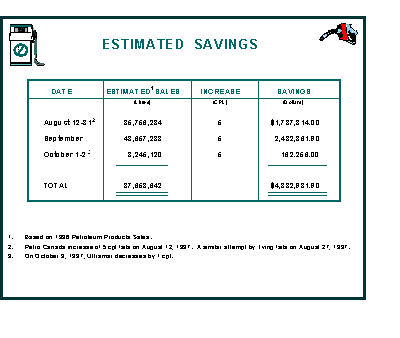
The presence of a monitor, watchdog, or consumer advocate has an effect on the market. In various meetings with oil company representatives and retailers, it was stated that the commissioning and workings of this study influenced pricing decisions in Newfoundland and Labrador in the last half of 1997. While the rest of North America was experiencing price increases in August and September, 1997, this Province had relatively stable pricing. In Newfoundland and Labrador, the Consumer Advocate was quick to respond to any unjustified price increases by calling for a complete explanation from industry. Price stability was the result and consumers saved approximately $4,382,931 when these attempted increases failed.(77)It is for this reason, and others, that it is recommended that the industry be monitored and that full and timely justification be provided for any price increase.
Publication
It is of little use to monitor the industry and collect the data as described if the information is not made available to the public. The monitor should publish, on a weekly basis, in newspapers having a general circulation in the Province, a compilation of the data in an understandable format. Additionally, the monitor should issue a report on the state of the industry once yearly. This report, to be published in a newspaper having a general circulation in the Province, should contain statistical information concerning the industry in a concise and understandable format. This information should include year over year tracking of the average pump price of regular unleaded gasoline sold in selected cities and towns in the Province, as compared to the St. John's and Montreal wholesale rack prices, as well as to the pump price for selected cities in Atlantic Canada (eg. Halifax, St. John and Charlottetown). Information concerning the number and location of outlet closures and openings over the year, together with the total volume of gasoline sold, and market share of each participant would also be useful.
A similar recommendation was made to Government in 1991, when it was proposed that "A price reporting, monitoring and publication system with appropriate competitive safeguards would likely be supported by industry as a way to demystify their complex and often criticized industry."(78)The Consumers Association of Canada supported the proposal, noting as well that it disagreed with price regulation.(79)
A monitoring program would have the added benefit of providing Government with an independent assessment and source of data concerning the gasoline retail industry. Obtaining a sound understanding of the retail sector should lend assistance to Government when introducing policy that effects the upstream sector of the industry.
Current Level of Monitoring
At present, little of this information is readily available to the public. Although this Study obtained information directly from the participants, a significant portion of the information used in this report was gleaned from alternative sources, including Natural Resources of Canada, Industry Canada, Statistics Canada, Provincial and Federal Departments of Finance, Provincial Departments of Mines and Energy and Government Services and Lands, various Boards of Public Commissions and Departments within the Governments of Nova Scotia, Prince Edward Island and New Brunswick, as well as general discussions with individuals in the community.
Evidence indicates that Measurement Canada, the agency responsible for verifying and ratifying the accuracy of the gasoline pumps used by the outlets, rarely attends to this duty. Undoubtedly, this is because of a lack of resources. However, studies indicate that upwards of 20% of the pumps in use in Atlantic Canada are inaccurate.(80)
The Ervin Report and the Refinery Report were intended by Natural Resources Canada and Industry Caada to provide a comprehensive examination of, respectively, the retail and refining gasoline industries in Canada. Both reports are, allegedly, studies of a national scope. However, few references concerning the Come By Chance Refinery could be found in the Refinery Report and it would appear that the Province of Newfoundland and Labrador was omitted from the Ervin Report in order to save money.(81)
The only conclusion one can draw is that complete reliance cannot be placed upon Natural Resources Canada or Industry Canada to provide the monitoring recommended in this study. Natural Resources Canada and Industry Canada seem fixated on the mainland market and are therefore unlikely to provide meaningful assistance in gathering and tracking statistical information for the Province of Newfoundland and Labrador as recommended.
Posting Prices
Similar to the effects of increased monitoring, the public display of pump price, or "curb-side pricing" as it is referred to in the industry, has a positive effect on competition. Government had introduced regulations which required curb-side pricing(82), however these regulations have since been repealed(83). We recommend that Government re-introduce these regulations, as not all station outlets are voluntarily posting their prices.
Public posting of prices will encourage station owners to match their price to the lowest price in the market. To prevent a permanent loss of market share, competitors must match the price. Although this leads to convergence in prices, for reasons as discussed earlier, the "same price everywhere" phenomena does not mean that there is a lack of competition in the marketplace.
Exit and Entry Barriers
The economic barriers which discourage both the entry and exit of participants into or from the retail gasoline market can have a significant impact on the level of efficiency at which the remaining participants operate, and as such, can have an impact on the level of competition itself. This impact on the level of competition in the market will, in turn, have an impact on the price of gasoline at the pump.
New entrants to the gasoline industry bring new capacity, the desire to gain market share and often downward pressures on the price of gasoline. There are five barriers to entry into or exit from a market relevant to the gasoline retail industry. They can be summarized as follows:
Economies of Scale
Economies of scale deter entry by forcing a potential participant to either enter in on a large scale or to accept a cost disadvantage. Economies of scale can act as barriers in production, distribution, research, marketing, utilization of the sales force, and financing.
Product Loyalty
Brand identification and influence of the individual dealer creates a barrier by forcing entrants to spend heavily to overcome customer loyalty. Advertising, customer service, being first in the industry, and product differences are among the factors fostering brand identification.
Capital Requirements
The need to invest large financial resources in order to compete creates a barrier to entry. Capital is necessary not only for fixed facilities but also for customer credit, inventories and absorbing start-up costs. The significant capital needed in order to enter the gasoline retail industry places a limit on the number of potential entrants.
Cost Disadvantages Independent of Size
Entrenched companies may have cost advantages not available to potential rivals, no matter what their size and obtainable economies of scale. These advantages can stem from the effects of the learning curve, proprietary technology, access to the raw material sources, or favourable locations.
Government Legislation
Environmental compliance legislation can impose significant cost barriers to the closure of a station, or the opening of a new station.
Specific Entry Barriers
As discussed earlier in the report, the construction or complete refurbishment of an outlet into a multi-service, multi-pump retail convenience centre can exceed two million dollars. While a more traditional gasoline only outlet, or gasoline outlet with only a convenience store can be built or refurbished for less money, the niche for these types of operations grows ever smaller as customers grow more attached to the concept of the one-stop shopping convenience centre. The "same price everywhere" phenomena all but precludes an outlet from competing on price, even if the outlet could survive on smaller margins because of its lower capital costs. The days of the gasoline only outlet operating in an urban environment are numbered. Similarly, customers can expect to see fewer gasoline only outlets in rural areas as well.
Perhaps the only place where the traditional gasoline only outlet will remain is in the isolated micro-market, as it is unlikely that the total volume of gasoline sold in the entire community would warrant the investment of a large multi-service, multi-pump convenience centre. As a result, an outlet located in a micro-market may not be in a position to take advantage of the efficiencies inherent in a larger operation.
In isolated micro-markets, the level of service may decline as unviable outlets close, and no new outlets open. If the number of competitors declines with the closing of the outlets, the isolated micro-market may continue to experience higher gasoline prices than the price experienced in urban areas of the Province.
This should be a concern to many towns and communities across the Province as higher prices for gasoline will have an impact on the cost of living, making it more difficult for those communities to attract commercial development and residents. However, communities and towns are not totally without recourse, as they have direct control over the second form of entry barrier - land use planning.
Some of the participants(84)described difficulties in obtaining permits from municipal authorities for the construction of new outlets. The difficulty is usually centered on zoning regulations and by-laws which were seen to unnecessarily impede the development of new sites.(85)
People buy 70% of their gasoline within a two kilometre radius of their residence.(86)Accordingly, shifts in population densities within a community will drive the need for a change in the location of an outlet or give rise to an opportunity to expand. The participant who is best situated to take advantage of a shift in the market, whether by closing an existing outlet and replacing it with a new or refurbished one, or developing an entirely new site, will come forward to seek approval of its plans from the municipal authority.
While, understandably, there is a concern that the development of a commercial operation at the site chosen by the applicant will not complement the neighbourhood in which it is to be located, the municipal authority should remain cognizant of the economics driving the application and, wherever possible, facilitate the applicant's plans. Only by encouraging the development of more efficient outlets can the municipality ensure that its citizens will be well served by the industry and avail of the lowest possible pump price.
Exit Barriers
The exit of a participant from the market can have a positive influence on the market by increasing the efficiencies of the remaining participants. In theory, these remaining participants will "pass" these efficiencies on to customers in the form of lower prices for their product. However, a participant who wishes to exit the market is faced with economic barriers.
The principle source of barriers to an exit from the market is related to environmental costs associated with decommissioning an outlet. Under our current regulations(87), a station owner must remove all underground storage tanks after the station becomes inactive. These regulations are intended to prevent the long term abandonment of underground storage tanks and thereby maintain the environmental integrity of the property. However, our regulations do not require the removal of tanks over a certain age.
The removal of underground storage tanks is an expensive proposition for a station owner.(88)In the instance where the outlet is owned, not by a major oil company, but instead, by an independent businessperson, as is the case in over 50% of the outlets in the Province, the cost associated with the removal of the underground storage tanks can be prohibitive. As such, the owner of the outlet may determine that it is cheaper to continue operating the outlet than to incur the cost of closing the station.
It is not a recommendation that Government should relax its environmental regulations. However, it is the combination of having regulations requiring the removal of tanks on closure of a station and lack of regulations requiring the removal of tanks of a certain age that can discourage environmentally sound decisions.
The closure of an unviable outlet may allow the remaining participants to increase their own throughputs and, accordingly, become more efficient operators. The actual effect felt by the closure of the outlet will depend on the dynamics of the particular market.
Role of the Independents
Independents account for almost 24% of gasoline sales in Canada. However, there are few Independents operating in Newfoundland and Labrador. Stuart Murray, President of Winnipeg-based Domo Gasoline oversees an Independent operation with seventy-three service stations in Western Canada. He has stated, "We have a good balance between majors and Independents in the West. You look at some of the things going on in the East and you shudder."(89)
While some participants are vertically integrated companies, owning and operating exploration divisions, oil producing properties, refineries and retail arms (eg. Imperial Oil and Petro Canada) and other participants are partly integrated, owning refineries and retail divisions but no upstream operations (eg. Irving Oil),an unbranded Independent is focused exclusively on the retail aspect of the industry. Independents can play a significant role in the market place. In Quebec, Independents have nearly a 25% share of the retail market.(90)Traditionally, Independents have competed on price in order to acquire and maintain a share of the market.
Since the consuming public displays a high sensitivity to price, Independents have been able to secure a significant share of the market by selling the same commodity as the majors at a reduced price.
However, as retail margins shrink for all participants, including the Independents, and competitors implement "no lower price" strategies, the Independents have found it increasingly difficult to maintain their price spread from the majors. Since the Independents may not be able to provide the same level of convenience shopping to the consumer as the majors, with their multi-service, multi-pump convenience centres, the Independents have seen either an erosion of their market share, or, in cases where additional stations have been added by Independents in order to maintain their market share, a lowering of the average throughputs and consequently, a lowering of efficiencies.(91)
As early as 1986 the Provincial Government had been concerned about the effect of competition in the industry and the lack of Independents in the Newfoundland and Labrador market. The Provincial Government stated(92):
"It (Senate Committee) might recommend action by an appropriate agency such as the Restrictive Trade Practices Commission to look into the whole question of competition within the industry at the retail end of its operations and to investigate the absence of competition in Newfoundland in particular, and any other parts of Canada where this is evident.
...
Action should be considered to review the circumstances of small distributors in the Newfoundland market to see how they might expand their operations without constraint by the major supplier companies."
The New Brunswick Report also studied this issue and found that Independents had an impact on pump prices. The committee examined the market in Nova Scotia and New Brunswick and concluded that counties possessing the most Independents had lower prices, and counties which had the highest degree of domination by a single outlet had the highest prices(93).
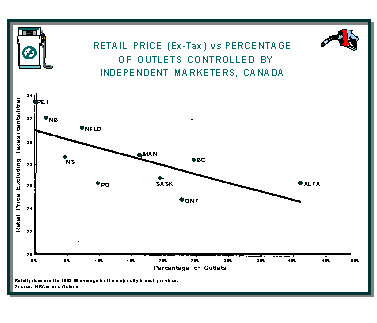
It is questionable whether the Independents will be able to continue this pattern, as oil companies have grown increasingly intolerant of price differentials within defined markets. This has led to price wars in some markets.
Price wars are usually caused by Independents attempting to maintain a price differential.(94)At times, during a price war, participants in the market may be forced to sell below cost. The Independents submit that the integrated oil companies unfairly take advantage of their ability to absorb losses at the retail level by providing product at the wholesale level to their own affiliates at below normal wholesale prices or by subsidizing the losses sustained at the retail level. As mentioned earlier, this is allowed under the Competition Act.(95)
In response, Independents have sought changes in Provincial or Federal legislation that would prohibit the integrated companies from selling retail gasoline for a price below a calculated wholesale level. This would prevent integrated companies from using profit earned in their refinery or wholesale divisions to subsidize the retail sector.
A second component of submissions often made by Independents would force the integrated oil companies to wholesale product at a posted price.
The Competition Act already addresses this second issue by making illegal the practice of selling the same product at different prices to different purchasers where the volume being purchased by each is approximately the same.(96)Industry Canada has recommended that the prices be posted to avoid any ambiguity on this point. However, legislation designed to force wholesale at a posted price regardless of volume would run counter to the well established economic principle that high volume purchasers will often obtain a discount on the wholesale price.
Restated, the first issue raised by the Independents alleges that they are victims of a predatory pricing strategy, employed by the majors.(97) The strategy, it is said, is to force the Independents into a costly price war, one which, comparatively speaking, they cannot afford to sustain as well as the majors. As a result, the Independents are either squeezed completely from the market place or so financially bruised that they are reluctant to trigger another price war and therefore maintain the price at a level equal to the majors, thus losing their competitive advantage. The Independents also state that the majors have used their excess earnings in their refining divisions to finance the refurbishment of the large convenience centres, money that is not available to the retail only Independent.
In one jurisdiction, the response has been to attempt to protect Independents by introducing legislation which prevents any participant from selling product at below cost.(98) As discussed earlier, there are cases where, during a price war, the market participants may end up selling their product for less than the wholesale cost. Since the volume of product sold by an outlet rises dramatically during these brief price wars, consumers attempting to take advantage of the drop in price, the participants can find themselves operating at a substantial loss.(99)
However, it is questionable whether the Quebec solution is ultimately workable as it will require their equivalent to our Public Utilities Board setting what is to be considered a reasonable return at the wholesale level at which point no participant can sell below.
It may be overly optimistic to conclude that Government, or the appropriate Public Utilities Board, would set the "reasonable return" at a point equal to or below the current market rate. Government should avoid any form of price regulation unless it is clear that the market is operating dysfunctionally. There is no evidence that this is the case.
However, it may be possible to resolve these issues without legislative intervention. Some Independents have suggested that their participation in the Province's marketplace could be secured if they were provided with a dependable independent source of product at the wholesale level. These Independents are of the view that they could operate in a viable manner even with the lower retail margins available to the participants, provided that they did not have to rely upon the major oil companies for their supply of product.
Industry Canada views the securing of an independently owned and operated terminal as a key factor in encouraging Independents to enter a market.
The greatest impediment to the establishment of a terminal for the storage of petroleum products is achieving compliance with environmental regulations. Government should work with private enterprise to develop a strategy that would achieve this objective. The Whiffen Head Storage Terminal, currently under construction, could be used to provide an independent supply of product to Independents operating in the Province. Alternatively, the existing terminal located in Long Pond, Conception Bay, could be used for this purpose.
Either of these sites could provide the separate gasoline supply sought by Independents.
66. Industry Canada, The Competition Act, The First One Hundred Years, 1996.
67. Correspondence, February 12, 1991.
68. Ervin Report.
69. Nova Scotia, Department of Mines and Energy, 1991.
70. Ervin Report.
71. NB Report.
72. British Columbia Inquiry Into Gasoline Pricing Final Report, September 30, 1996 (hereafter the "BC Study").
73. Lerner.
74. Competition Bureau, News Release, March 18, 1997.
75. B.C. Study, Ervin Report.
76. Eg. Quebec Study, NB Report, Ontario's North-South Report, 1986.
77. Estimated savings may be overstated as consumers may have purchased less gasoline following a five cent per litre increase in pump price.
78. Newfoundland and Labrador, Department of Mines and Energy.
79. Newfoundland and Labrador, Background Paper Petroleum Product Price Submission, 1991.
80. Octane Magazine, Summer 1995.
81. Meetings with Natural Resources Canada.
82. Petroleum Product Price Posting Regulations, Reg. 38-93.
83. Regulatory Reform Project, 1995.
84. Industry.
85. In most towns and communities in the Province the local council is responsible for approving zoning permits.
86. CPPI presentation on gasoline pricing to the standing committee on natural resources; NB. Ken Brown (Report concerning the Gasoline Inquiry) states that consumers tend to use stations within a 5 mile radius of where they live, provided that they live in a populated area.
87. Storage and Handling of Gasoline and Associated Products Regulation, 1982.
88. The cost of removing tanks without contamination that needs to be remediated can in itself exceed $50,000. The cost of an aggressive remediation program in the event of a spill can cost in the hundreds of thousands of dollars.
89. Macleans Magazine, October 7, 1996.
90. Repport du Comite Special D'Examen de la Situation du March de l'Essence au Quebec, October 8, 1996, Ervin.
91. Imperial Oil Presentation to the Quebec Commission, 1996.
92. Newfoundland and Labrador, Submission to the Senate Standing Committee on Energy and Natural Resources, 1986.
93. NB Report.
94. Lerner.
95. Competition Act, s. 45.
96. Competition Act, s. 50.
97. Discussions with Independents.
98. As of the time of writing, the Quebec commission had not yet set an acceptable benchmark for the return at the wholesale level.
99. If, during a price war, the price per litre for regular unleaded gasoline drops twenty cents, a 1.5 million litre station selling product at 100% above normal volumes during the price war would lose in over $1,200 per day plus operating costs.
