

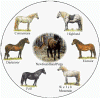
The Newfoundland Pony is the Province of Newfoundland & Labrador’s first Heritage Animal. Derived from those pony breeds that were brought over from the British Isles in the early days of European settlement, this pony has now evolved into a breed type that reflects the historical needs for a draft animal in this climate. This factsheet highlights the characteristics of the foundation breeds for this pony as well as its current appearance.
Foundation Breeds
The pony breeds brought over to Newfoundland with early settlers (400 or more years ago) that influenced the development of the Newfoundland Pony were primarily the Exmoor, Dartmoor and New Forest. Significant influence also came from the Galloway, Connemara and Welsh Mountain and possibly the Highland. Individual ponies today bear more or less resemblance to one of these ancestors.
All ponies are under 14 hands two inches at withers height (bottom of pony’s neck). One hand is four inches, so 14 hands two inches (written as 14.2 hands) translates into 58 inches or approximately 147 centimeters. The characteristics of these different foundation breeds are:
(Up to 12.3 hands)
This hardy, strong-willed pony is the oldest breed in Britain, and still lives half wild in herds on Exmoor. It is always brown or bay, with a light belly and nose. It is a very popular riding pony for children.
(Up to 12.2 hands)
This tough little British pony roams half wild on Dartmoor. It is intelligent and sure-footed, and makes a good children’s riding pony. Its coat may be bay, black or brown. It also has a small, pretty head.
(Up to 14.2 hands)
This intelligent, strong and versatile pony is usually bay, brown or gray though chestnuts, roans and blacks are seen. Similar to the Dartmoor and Exmoor, their gentle disposition makes them excellent ponies for children.
(Up to 14.2 hands)
This large (up to 14.2 hands) trekking pony comes from the highlands of Scotland.It is usually grey or dun, but can also be black or chestnut. It grows a long coat in winter. It has a thick mane and tail.
(Up to 12 hands)
This old breed comes from Wales and is a popular pony for riding and driving. It has Arab and thoroughbred blood, which gives it an elegant head. Its coat can be any shade except piebald or skewbald.
(13-14.2 hands)
This attractive pony comes from northwest Ireland, and was probably first bred from Spanish and Arab horses. It is fast and sure-footed. Its coat is usually grey, but can also be dun, black, brown, bay or chestnut.
More Information
If you would like more information on the Newfoundland Pony, please contact the Newfoundland Pony Society .
This factsheet was written by the Newfoundland Pony Society and Agrifoods, sources of information include “Usborne Spotter’s Guides – Horses and Ponies, EDC Publishing”; and “The Newfoundland Pony”, by Dr. Andrew Fraser, published by Creative Press.