

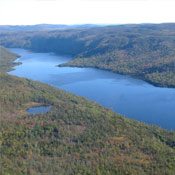
Located in the scenic hills of western Newfoundland, the 729 km2 Little Grand Lake Provisional Ecological Reserve protects extensive areas of bog, barrens, and mature boreal forest – important habitat for the Newfoundland marten.
- How to get There
- Activities
- Maps
- Services
- Fees and Schedules
- Rules and Regulations
- Permits
- Other Resources
- Contact Information
The reserve’s borders were designed to capture specific ecosystems while also providing a high level of protection for core marten habitat, Little Grand Lake Provisional Ecological Reserve is one of three conservation areas surrounding Little Grand Lake. Together with Little Grand Lake Wildlife Reserve (569 km2) and Glover Island Public Reserve (178 km2), these areas help conserve and maintain important habitat for the Newfoundland marten.
The Little Grand Lake Provisional Ecological Reserve was legally established in 2002, following many years of interest in conserving the area and its wildlife. The adjacent wildlife and public reserves were also created in 2002. Under the Lands Act, Glover Island was last renewed as a Public Reserve in 2013 for a 20 year period.
The Little Grand Lake Provisional Ecological Reserve includes representative portions of three natural regions:
- Western Newfoundland Forest-Corner Brook subregion (928 KB)
- Central Newfoundland Forest-Portage Pond subregion (902 KB)
- Long Range Barrens-Buchans Plateau/Topsails subregion (1.0 MB)
Ecotones – areas where these regions overlap – are also included inside the conservation system. These transition zones support high biodiversity. The area provides habitat for a variety of plant and animal species, including woodland caribou, which frequent the bogs, ribbed fens, and barrens of the Buchan’s Plateau-Topsail subregion.
Newfoundland Marten
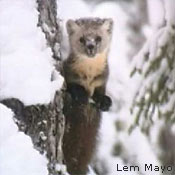
The Newfoundland marten is one of only 13 mammal species native to the Island of Newfoundland. The Newfoundland marten is in the same family as the weasel, mink, and ferret but is a geographically isolated and genetically distinct population.
First listed as endangered in 1996, the species was formally designated under the provincial Endangered Species Act in 2002. Long-term recovery efforts have led to steady population growth, allowing its status to improve from Endangered to Threatened in 2007, and to Vulnerable in 2024.
This recovery reflects decades of collaborative conservation efforts involving government, Indigenous groups and organizations, the trapping sector, stewardship organizations, the forestry industry, and the public.
Newfoundland marten depend on mature, closed-canopy forest – habitat that is limited on the Island. The forests within the Little Grand Lake Reserve System continue to support one of the largest and most important core populations of this species.
How to get there
The reserve is located:
- 20 km southeast of Corner Brook
- 40 km southwest of Buchans
- 30 km south of Deer Lake
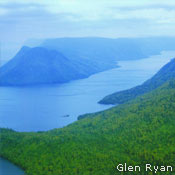
Access is mainly via old forest access roads, which provide opportunities for vehicle travel and hiking. The forest resource road network surrounds the reserve, including North Harbour, Lady Slipper, Gull Pond, Pelley’s Brook, Camp 185, Portage Lake, Lloyds River, Star Lake, and the Burgeo Highway (Route 480). Most of these roads do not cross the reserve boundary. The Camp 185 network is the only road that provides direct access; however, much of the road is in poor condition (e.g., washouts and overgrown sections). Visitors are advised to use caution.
Boaters on the Grand Lake system should also exercise care. Hazards include limited sheltered coves, steep shorelines, and submerged debris such as sunken tree trunks near shore.
Note: All-terrain vehicles (ATVs) are not permitted in the reserve.
Activities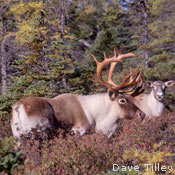
Primary activities in the reserve include:
- Hunting
- Fishing
- Outfitting
- Scientific research
For research guidelines, see Science and Research.
Services
Three outfitters offer guided hunting experiences within the reserve:
- Caribou Valley Outfitters
- Moose Valley Outfitters
- Twin Valley Outfitters
For more information, please consult the Government of Newfoundland and Labrador’s Annual Guide to Hunting and Fishing Outfitters.
Fees and Schedule
There are no fees to visit the reserve or to obtain permits.
Rules and Regulations
The public can visit most ecological reserves for educational purposes or low-impact recreational activities, such as hiking or sightseeing. Some rules and regulations are specific to each reserve, while others apply to all wilderness and ecological reserves.
The following activities are prohibited in all wilderness and ecological reserves:
- Disturbing, destroying, or removing plants, animals, or fossils
- Introducing plants, animals, or anything else to the reserve landscape
- Forestry, mining (including exploration), hydro development, agriculture, new roads, tracks, or building construction
- Driving off-road vehicles including ATVs
Entry permits are not required in Little Grand Lake Provisional Ecological Reserve. The following rules and regulations are in place:
Permitted:
- Hunting and fishing with a valid permit
- Camping
- Snowmobiling
- Motorized boating
- Aircraft landings
- Trapping
Prohibited:
- Use of ATVs (including for game retrieval)
- Small game snaring
Read the official reserve regulations:
- Little Grand Lake Provisional Ecological Reserve Regulations
- Little Grand Lake Provisional Ecological Reserve Order
- Wilderness and Ecological Reserves Act
Regulations and a management plan are pending for the Little Grand Lake Provisional Ecological Reserve.