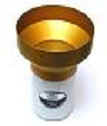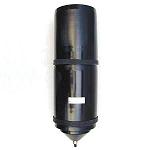

The Pippy Park Weather Monitoring Station is equipped with the following sensors:
Temperature
Temperature is measured in oC using a Vaisala Relative Humidity and Temperature sensor. The sensor measures both temperature and relative humidity. The sensor is housed in a gill radiation shield. Its construction allows air to pass freely through the shield thereby keeping the probe at or near ambient temperature. The shield is white in color so it can reflect solar radiation. The gill radiation shield also provides protection for the sensor. The operating temperature range for the sensor is -40o Celsius to +60o Celsius.

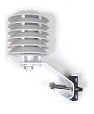
Relative Humidity
Relative Humidity is measured in percent using Vaisala Relative Humidity and Temperature sensor. The sensor measures both temperature and relative humidity. Relative Humidity indicates how moist the air is. Relative Humidity is defined by the following equation:
Relative Humidity (RH) =e/ e5 x 100%
where RH is Relative Humidity, e is the vapour pressure in kPa, and e5 is the saturation vapour pressure in kPa. The vapour pressure, e, is an absolute measure of the amount of water vapour in the air and is related to the dew point temperature. The saturation vapour pressure is the maximum amount of water vapour that air can hold at a given temperature.
When the air temperature increases, so does the saturation vapour pressure. Conversely, a decrease in air temperature causes a corresponding decrease in saturation vapour pressure. It follows then from the above equation that a change in air temperature will change the relative humidity, without causing a change in absolute humidity.
The measurement range for Relative Humidity is 0 to 100% non-condensing with accuracy of ± 2% over 10-90% RH and ± 3% over 90-100% RH.
Wind Speed and Direction
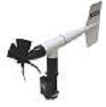
The wind monitor measures horizontal wind speed and direction. The propeller-type wind monitor is a sturdy instrument for measuring wind speed and direction in harsh environments. The wind monitor’s design emphasizes simplicity and lightweight construction. Thermoplastic materials offer resistance to corrosion from sea air environments and atmospheric pollutants.
Precipitation
The tipping bucket rain gauge funnels precipitation into a bucket mechanism that tips when filled to a calibrated level. A magnet attached to the tipping mechanism actuates a switch as the bucket tips. The momentary switch closure is counted by the pulse-counting circuitry of the data logger.
A snow fall adaptor can be placed on the rain gauge that allows measurement of the water content of snow during winter months.