
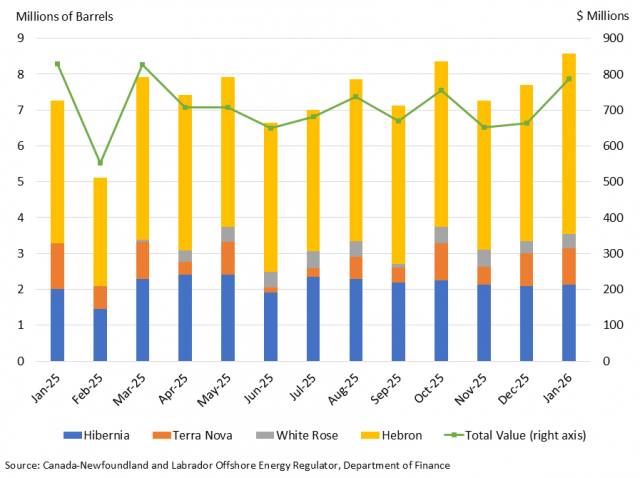
According to the Canada-Newfoundland and Labrador Offshore Energy Regulator (C-NLOER), 8.6 million barrels of oil were extracted from offshore Newfoundland and Labrador in January 2026, an increase of 17.9% compared to January 2025. The corresponding value of production totalled $786.8 million, a decrease of 5.1%.
- The increase in production was mainly driven by a 26.3% rise in output at Hebron, which reached a record monthly high in January 2026, exceeding five million barrels for the first time since the project began in November 2017. Production also increased at Hibernia (+5.1%) but declined at Terra Nova (-19.8%). Output at White Rose remained steady relative to recent months; the SeaRose FPSO resumed operations on March 13, 2025, after being offline since January 2024 for a refit.
- Brent crude oil prices averaged US$66.60/barrel in January 2026, a 16.0% decrease from US$79.27/barrel in January 2025.
Through January and into early 2026, global oil market conditions continued to be shaped by OPEC+ supply decisions, evolving U.S. tariff policy, and rapidly intensifying geopolitical risks driven by the Iran war.
- OPEC+ maintained voluntary cuts through mid‑2025 but began gradually unwinding them throughout the remainder of the year, most recently approving a 206,000 barrel per day increase for April 2026, with flexibility to pause or reverse depending on market conditions.
- U.S. tariff policy shifted in early 2026 after a Supreme Court ruling invalidated existing tariffs. The U.S. administration subsequently imposed a temporary 10% global tariff, potentially rising to 15%. Most Canadian crude, including exports from Newfoundland and Labrador, continues to enter the U.S. duty‑free under CUSMA.
- Geopolitical tensions escalated sharply in late February 2026, as U.S.–Israeli strikes and Iranian retaliation effectively shut down the Strait of Hormuz, halting most tanker movements and damaging key regional energy infrastructure. The disruption of a corridor that normally carries about 20% of global oil supply has become the dominant driver of market volatility, likely limiting the impact of any OPEC+ production increases.
- Oil prices recently climbed to their highest levels since 2024, with Brent crude surpassing $90 per barrel in early March, an increase of nearly 50% from the start of the year. Analysts warn that if disruptions to the Strait of Hormuz persist, prices could rise toward, or surpass, $100 per barrel.
The estimated value of Newfoundland and Labrador’s crude oil output is in Canadian dollars; the average Canada-U.S. exchange rate in January 2026 stood at 72.6 cents/U.S. dollar, compared to 69.5 cents/U.S. dollar in January 2025.
Further information on the province’s oil and gas industry is available in The Economy 2025 (see Oil and Gas section).
Statistical Reference: Statistics used in this analysis were current at the time of writing. For the latest in oil production statistics visit the Newfoundland & Labrador Statistics Agency site.