
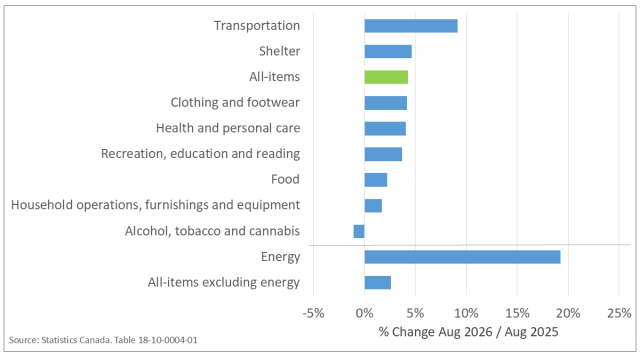
According to the Consumer Price Index (CPI), consumers in Newfoundland and Labrador paid 4.3% more for goods and services in August 2026 than in August 2025.
Prices increased in most major categories in August 2026 compared with August 2025, led by the ‘Energy’ index.
- Energy prices continued to rise in August 2026, with an increase of 19.2%, reflecting significant increases in ‘Fuel oil and other fuels’ (+61.7%) and ‘Gasoline’ (+28.0%).
- These increases were driven largely by higher oil prices. Brent crude oil averaged US$91.08 per barrel in August 2026, up 34.2% from August 2025, primarily reflecting supply concerns associated with conflict in the Middle East.
- The removal of the federal fuel excise tax on April 20, 2026, partially offset upward pressure on gasoline prices; however, this effect was more than outweighed by higher crude oil prices.
- Prices for ‘Transportation’ increased by 9.2%, driven primarily by higher gasoline prices.
- Prices for ‘Shelter’ increased by 4.7%, continuing to be a significant contributor to overall inflation.
- There was an increase in the ‘Rented accommodation’ index (+7.2%), which includes rent costs, and an increase in the ‘Owned accommodation’ index (+2.1%), which includes mortgage interest costs.
- Shelter price changes were also influenced by higher prices for both ‘Fuel oil and other fuels’ (+61.7%) and ‘Electricity’ (+2.2%). Electricity rates in Newfoundland and Labrador increased by an average of 2.3% effective July 1, 2026, following rate changes implemented by Newfoundland Power, the province’s primary electricity retailer.
- ‘Food’ prices increased by 2.2% in August 2026 compared with August 2025, down from a 3.2% increase in July 2026. Prices increased for both ‘Food purchased from stores’ (+1.6%) and ‘Food purchased from restaurants’ (+3.5%).
- Higher prices for ‘Fish, seafood and other marine products’ (+4.6%) and ‘Fruit, fruit preparations and nuts’ (+3.8%) contributed most to the increase in prices for food purchased from stores.
The ‘All-items excluding energy’ index increased by 2.6% in August 2026 compared with August 2025, indicating that underlying inflationary pressures remained more moderate outside of energy-related components.
At the national level, the CPI increased by 3.0% on a year-over-year basis in August 2026, on par with the increase in July but up from 2.8% in June 2026. Among the provinces, inflation rates ranged from 2.4% in Ontario to 5.1% in Nova Scotia.
On a seasonally adjusted basis, consumer prices in Canada increased by 0.2% from July to August 2026. Seasonally adjusted CPI data are not available for Newfoundland and Labrador.
The United States CPI for all urban consumers increased by 3.4% in August 2026 compared with August 2025. The seasonally adjusted index increased by 0.4% in August 2026 compared with July 2026.
On a year-to-date basis, consumers in Newfoundland and Labrador paid 3.4% more for goods and services in the January to August 2026 period compared with the same period in 2025, led by higher prices for ‘Transportation’ (+4.4%), ‘Shelter’ (+3.9%) and ‘Food’ (+3.8%).
Year-Over-Year Change in CPI, August 2026 vs. August 2025
Statistical Reference: For the latest in consumer price index statistics visit the Newfoundland & Labrador Statistics Agency site and check the release dates on the Statistics Canada site.