
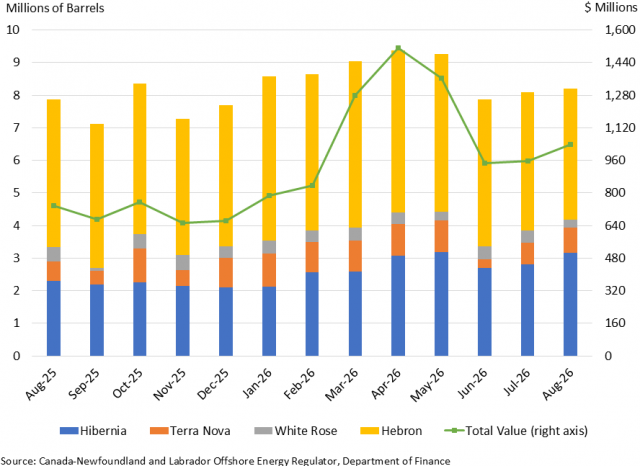
According to the Canada-Newfoundland and Labrador Offshore Energy Regulator (C-NLOER), 8.2 million barrels of oil were produced offshore Newfoundland and Labrador in August 2026, an increase of 4.4% compared with August 2025 (see Figure 1). The value of production totalled nearly $1.0 billion, up 41.1% year over year.
- Production increased at Hibernia and Terra Nova in August 2026 compared with one year earlier, while it declined at Hebron, White Rose and North Amethyst. The increase in production at Hibernia and Terra Nova more than offset the declines recorded at other oilfields.
- Brent crude oil prices averaged US$91 per barrel in August 2026, up 34.2% from US$68 per barrel in August 2025, but down from US$107 per barrel in May 2026.
Global oil markets have remained highly sensitive to developments in the Middle East throughout 2026. While the conflict remained the primary source of price volatility, market sentiment increasingly reflects changing expectations around supply disruptions, OPEC+ production policy, global oil inventories and the strength of global demand.
- Concerns over the security of energy supplies further intensified following the disruption of shipping through the Bab el-Mandeb Strait, a major global oil transit chokepoint and an alternative route to the Strait of Hormuz, which has remained largely closed since late February. Both waterways normally handle a significant share of global seaborne oil trade, and disruptions to tanker traffic and regional energy infrastructure contributed to a sharp increase in crude oil prices and market uncertainty.
- Brent crude spot prices began the year slightly above US$60 per barrel before rising rapidly as the conflict escalated, reaching a peak of US$138 per barrel on April 7, the highest daily level since 2008. Prices remained elevated throughout much of the second quarter and into the third quarter as markets assessed the potential duration and severity of supply disruptions.
- Oil prices moderated in June as diplomatic negotiations reduced immediate concerns over global supply availability. However, recurring outbreaks of hostilities and uncertainty surrounding a long-term settlement continued to support a geopolitical risk premium in crude oil markets. Prices strengthened again in August as ceasefire arrangements deteriorated and conflict resumed. The Strait of Hormuz remained effectively closed throughout August, in addition to disruptions at the Bab el-Mandeb Strait.
- OPEC+ maintained October 2026 production targets at September 2026 levels, signaling a pause in the unwinding of earlier voluntary production cuts. Nevertheless, actual output growth may remain constrained in some member countries due to infrastructure damage, logistical challenges, and transportation bottlenecks associated with the conflict.
- Despite ongoing supply concerns, downward pressure on prices emerged from weaker global demand growth, particularly in major consumer economies, together with increases in non-OPEC production and the release of oil from commercial inventories and strategic reserves. These factors helped moderate price increases but were insufficient to eliminate the elevated level of geopolitical uncertainty reflected in energy markets.
The estimated value of Newfoundland and Labrador’s crude oil output is reported in Canadian dollars; the average Canada-U.S. exchange rate in August 2026 stood at 72.0 cents/U.S. dollar, compared with 72.5 cents/U.S. dollar in August 2025.
On a year-to-date basis, the volume of oil production from offshore Newfoundland and Labrador increased by 20.9% in the January to August 2026 period compared with the same period in 2025. The corresponding value of production totalled $8.7 billion, up 53.3% compared with the same period last year. This represents the second-highest year-to-date value of production on record for the January to August period, trailing only the corresponding period in 2008.
Further information on the province’s oil and gas industry is available in The Economy 2026 (see Oil and Gas section).
Statistical Reference: Statistics used in this analysis were current at the time of writing. For the latest in oil production statistics visit the Newfoundland & Labrador Statistics Agency site.