
Quarterly Data
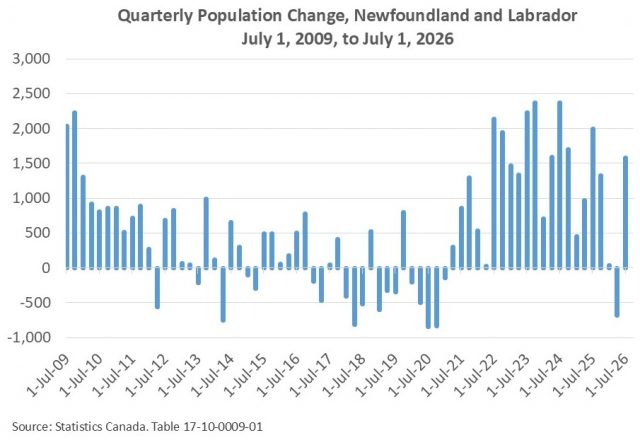
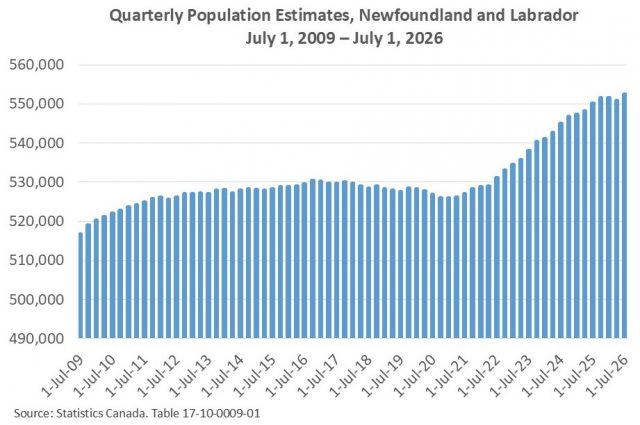
Preliminary demographic estimates indicate that the population of Newfoundland and Labrador stood at 552,462 as of July 1, 2026. According to these estimates, the population of Newfoundland and Labrador increased by 1,581 persons (or 0.3%) from April 1, 2026, to July 1, 2026.
Newfoundland and Labrador’s Q2 2026 population change resulted from gains in net migration, partly mitigated by losses in the natural population change (fewer births than deaths). Net migration totalled 2,341 persons in Q2 2026. Natural population change (births less deaths) was negative, down by 760 persons.
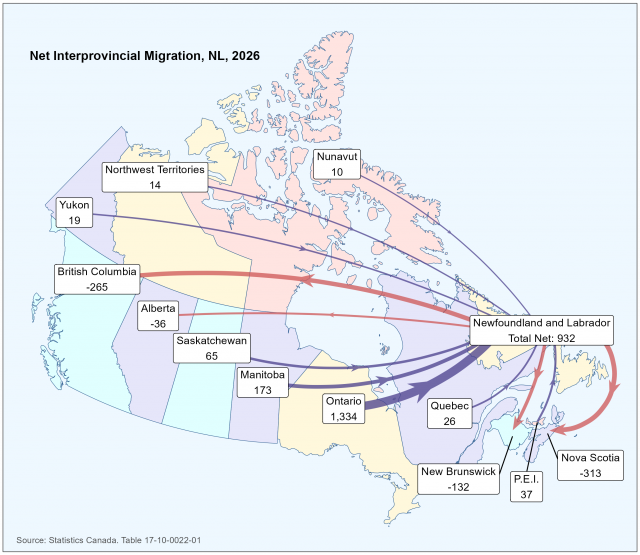
Net gains were recorded in both international migration (+1,760) and interprovincial migration (+581). International migration gains in Q2 2026 stemmed from a large influx of permanent (or landed) immigrants (+1,557) and an increase in net non-permanent residents (+239). On an interprovincial basis, the largest net gain in Q2 2026 was from Ontario (+578). The largest net migration loss was to Nova Scotia (-141).
At the national level, Canada’s population grew by 80,343 persons, or 0.2%, from April 1, 2026, to July 1, 2026. Most of the growth in Q2 2026 was due to international migration (+67,384 people).
Note that these preliminary demographic estimates are subject to revision in future releases, following the standard process used by the Demographic Estimates Program at Statistics Canada.
Annual Data
From July 1, 2024, to July 1, 2025, Newfoundland and Labrador’s population increased by 2,260 persons (or 0.4%), the sixth consecutive annual increase since a 0.1% decline in 2020.
The annual population increase in the province was driven by gains in international migration and interprovincial migration, mitigated by losses in natural population change (lower births than deaths). Net international migration increased by 4,567 persons, reflecting a near-record number of immigrants (+5,311), partially offset by a decline in net non-permanent residents (-560). Net interprovincial in-migration was positive for a sixth consecutive year (+932). The largest net gain was from Ontario (+1,334) and the largest net losses were to Nova Scotia (-313) and British Columbia (-265).
Losses from natural population change have been accelerating for the last ten years, reflecting an aging population. The births-to-deaths ratio for Newfoundland and Labrador in 2026 (0.5) was the lowest of all provinces. Other provinces with a ratio below the Canadian average (1.1) include; New Brunswick (0.7), Nova Scotia (0.7), Prince Edward Island (0.9), Quebec (1.0) and British Columbia (1.0).
Canada’s population was estimated at 41,798,407 on July 1, 2026, an increase of 189,425 people (+0.5%) from July 1, 2025. This marks the lowest annual growth rate in recent history.
Note that these annual population estimates are also preliminary and will be revised several times before becoming final.
| Components of Population Change, Newfoundland and Labrador | ||
|---|---|---|
| 2026 Q1 → Q2 | 2025 → 2026 | |
| Previous Population (as of) | 550,881 (April 1, 2026) | 550,202 (July 1, 2025) |
| Total Net Migration | 2,341 | 5,499 |
| Inter-provincial net-migration | 581 | 932 |
| Inter-provincial in-migration | 2,783 | 6,644 |
| Inter-provincial out-migration | 2,202 | 5,712 |
| Net International Migration | 1,760 | 4,567 |
| Natural Population Change | -760 | -3,239 |
| Births | 868 | 3,368 |
| Deaths | 1,628 | 6,607 |
| Most Recent Population (as of) | 552,462 (July 1, 2026) | 552,462 (July 1, 2026) |
Statistical Reference: Statistics used in this analysis were the latest available at the time of writing. For the latest in population statistics visit the Newfoundland & Labrador Statistics Agency site.
Provincial population projections are also available by age, gender and various levels of geography.