According to the Consumer Price Index (CPI), consumers in Newfoundland and Labrador paid 4.2% more for goods and services in July 2026 than in July 2025.
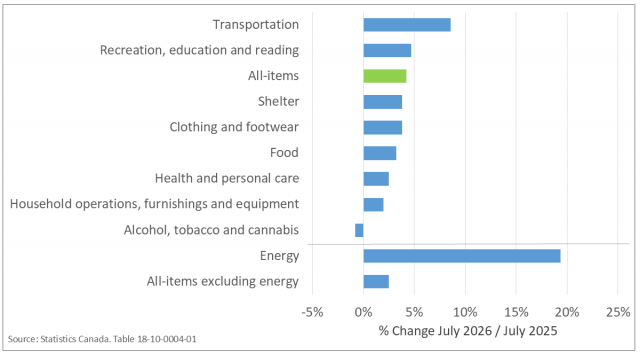
Prices increased in most major categories in July 2026 compared with July 2025, led by the ‘Energy’ composite index.
- In July 2026, ‘Energy’ prices rose by 19.4% after increasing by 17.4% in June, 25.7% in May and 21.6% in April 2026. This reflected significant increases in ‘Fuel oil and other fuels’ (+41.8%) and ‘Gasoline’ (+30.9%).
- These increases were driven by higher oil prices. The price of Brent crude oil averaged US$83.76 per barrel in July 2026, an increase of 17.9% compared with July 2025, primarily due to the conflict in the Middle East.
- The year-over-year price increase for gasoline in July was also influenced by the switch to the more expensive summer blend. However, the federal fuel excise tax was removed on April 20, 2026, slightly moderating the increase in gasoline prices.
- Prices for ‘Transportation’ increased by 8.6%, driven mainly by higher fuel prices.
- Prices for ‘Shelter’ increased by 3.8%.
- There was an increase in the ‘Rented accommodation’ index (+6.1%), which includes rent costs, and an increase in the ‘Owned accommodation’ index (+1.7%), which includes mortgage interest costs. While the mortgage interest cost index is not available for Newfoundland and Labrador, it declined at the national level in July 2026 (-0.3%).
- Shelter price changes were also affected by higher prices for both ‘Fuel oil and other fuels’ (+41.8%) and ‘Electricity’ (+2.2%). Electricity rates in Newfoundland and Labrador increased by an average of 2.3% effective July 1, 2026, as implemented by Newfoundland Power, the province’s primary electricity retailer.
- ‘Food’ prices increased by 3.2% in July 2026 compared with July 2025, following a 2.3% increase in June 2026. Prices increased for both ‘Food purchased from stores’ (+3.1%) and ‘Food purchased from restaurants’ (+3.5%).
- Price increases for food purchased from stores were largely attributable to higher prices for ‘Meat’ (+6.8%), ‘Fruit, fruit preparations and nuts’ (+4.1%) and ‘Dairy products and eggs’ (+3.9%).
The ‘All-items excluding energy’ index increased by 2.5% in July 2026 compared with July 2025.
At the national level, the CPI increased 3.0% on a year-over-year basis in July 2026, up from 2.8% in June 2026. Inflation by province ranged from 2.0% in Ontario to 5.0% in Nova Scotia.
On a seasonally adjusted basis, consumer prices in Canada increased by 0.3% from June to July 2026. Seasonally adjusted CPI data are not available for Newfoundland and Labrador.
The United States CPI for all urban consumers increased by 3.4% in July 2026 compared with July 2025. The seasonally adjusted index decreased by 0.1% in July 2026 compared with June 2026.
On a year-to-date basis, consumers in Newfoundland and Labrador paid 3.2% more for goods and services in the January to July 2026 period compared with the same period in 2025, led by higher prices for ‘Food’ (+4.0%), ‘Shelter’ (+3.8%), and ‘Transportation’ (+3.7%).
Year-Over-Year Change in CPI, July 2026 vs. July 2025
Statistical Reference: For the latest in consumer price index statistics visit the Newfoundland & Labrador Statistics Agency site and check the release dates on the Statistics Canada site.